
Tank To Table: Momentum Builds For Local Shrimp Company
By Art Bukowski | Jan. 2, 2026
Local cherries. Local beef. Local…shrimp?
Carol and Stephen Karas might spend more time explaining their operation than actually running it, as most people struggle to wrap their heads around the concept.
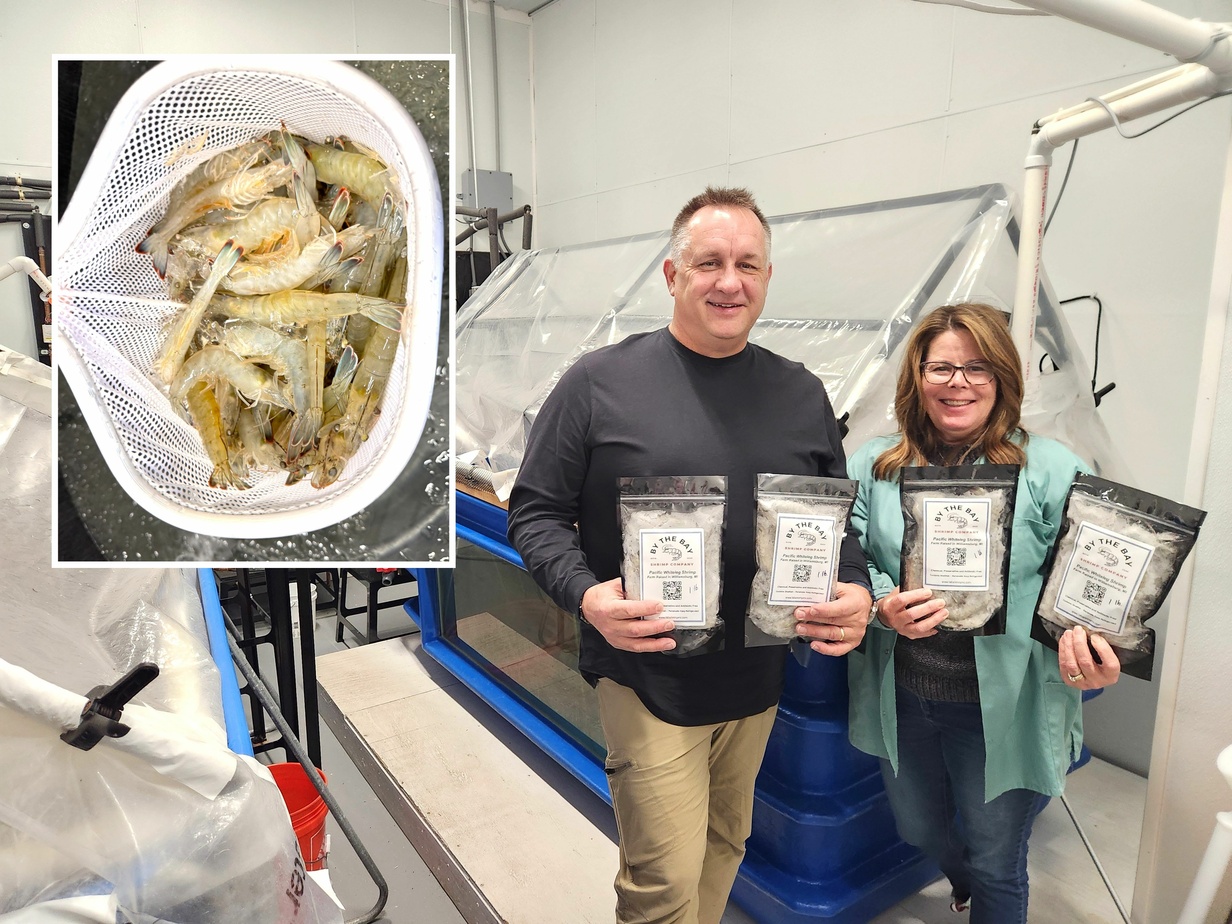
Yes, the shrimp they raise and sell at By The Bay Shrimp Company are grown right here in Williamsburg. No, not in the bay, as a surprising amount of people ask. It’s an entirely indoor operation, with these scrumptious saltwater shrimp (Pacific white shrimp, to be specific) reared in specially designed tanks in an enclosed aquaculture system.
What started as a “proof of concept” for these two longtime local realtors has now grown into a business that delivers shrimp to Burritt’s, Oryana, Maxbauer’s and Edson Farms, along with dreams of a much larger operation.
“I want to have a shrimp empire,” Carol tells The Ticker. “I want to have my own brood stock; I want to be able to control every bit of it. And one day, when we're big enough, you can scan a QR code and see where your shrimp originated from, which brood stock and when it was harvested.”
It’s not ambition or ego that drives Carol. It’s a steadfast belief that what they’re doing is good for people, the planet and the product.
“We are so far behind in the United States on indoor aquaculture,” she says. “It’s a controlled environment. The feed's controlled, the temperature, the water, everything's controlled. You can have a healthy, beautiful, wonderful product.”
While The Ticker was not able to independently confirm this week, the Karases say they are the only licensed commercial shrimp outfit in the state and one of only a handful of indoor operations in the country (other operations previously existed in Michigan, but have since closed).
Carol, who already kept saltwater corals and fish, got the shrimp idea while writing a research paper on aquaculture a few years back while pursing a marine biology degree from Unity Environmental University in Maine. The vast majority of the country’s shrimp supply is imported, she learned, much of it from southeast Asian farms with questionable practices.
The Karases knew that Traverse City, already a foodie, farm-to-table hotspot, would be a great place to launch a shrimp farm. And regardless of the location, who doesn’t love shrimp?
“It’s shrimp,” Carol says. “It’s high protein. Everybody loves it. Everybody has it for cocktails, weddings, anniversaries.”
They set up the farm in a barn on their property last year and produced their first full batch of a few hundred pounds in April. They’re now on batch three, as it takes several months to raise them from larvae to edible size.
“Our hope was that because of the whole farm to table thing that it would take off,” Stephen says. “We’ve gotten really good reception, but you’ve got to sell people on it. It’s not something you can just put on the shelf. You kind of have to (explain it) right now, because people don’t understand.”
Part of what needs to be explained is why these shrimp come fully intact with the head on (it’s in large part because By The Bay is only licensed to grow shrimp, not process them). While that’s a far cry from the orange, headless, pre-peeled shrimp found in supermarket trays, the Karases say one taste is all it takes to really appreciate the difference.
“When you taste them, and I'm obviously biased, but this is what everybody's told us as well, is it's a sweeter, better tasting shrimp,” Stephen says. “And they cook very quickly – about half the time as a normal shrimp – because they haven’t sat on a boat or a plane or something.”
If demand continues to grow, the Karases hope to build more production in a modular fashion so they can harvest shrimp at least once a month. Instead of retrofitting an existing structure, new “pods” will be specifically designed and built for this purpose to better control temperature and other variables.
Jake Kaberle owns Burritt’s. They’ve sourced high-quality, wild caught shrimp from the Gulf and the Pacific, but he says By The Bay’s stuff is as good or better.
“This fall I put Steve and Carol out front at a table and we steamed some of their shrimp. And almost every person that tried it bought some because they absolutely loved it,” Kaberle tells The Ticker. “The flavor is close to perfect (from their) lack of chemicals in their rearing process. And it's just so fresh, it gives the shrimp an amazing texture.”
Kaberle is excited to sell the Karases’ shrimp for years to come.
“It’s been really exciting to have something that’s so sustainable and raised right here in northern Michigan,” he says. “I’m looking forward to what’s to come from By The Bay.”
Comment

Tank To Table: Momentum Builds For Local Shrimp Company
Read More >>Last Looks At 2025: The Year's Most Eye-Popping Numbers, From Airport Traffic To Food Insecurity
Read More >>Traverse City’s Most Violent Year? Crime Stories Dominate The Ticker’s 2025 Top 8
Read More >>TCAPS Accepts State Funding Tied to Controversial Mandate
Read More >>



Man Faces Multiple Charges After Crashing Into TC Snowbank
Read More >>Downtown TC to Host "Community Canvas" Art Event
Read More >>Priorities Emerge for East Bay TIF Plan
Read More >>Welcome To The Open Space
Read More >>Shining Bright: East Bay Home A Fixture During Holiday Season
Read More >>From Ski Resort Conditions to Snow-Clearing Updates, Here’s Your Winter Break Report
Read More >>